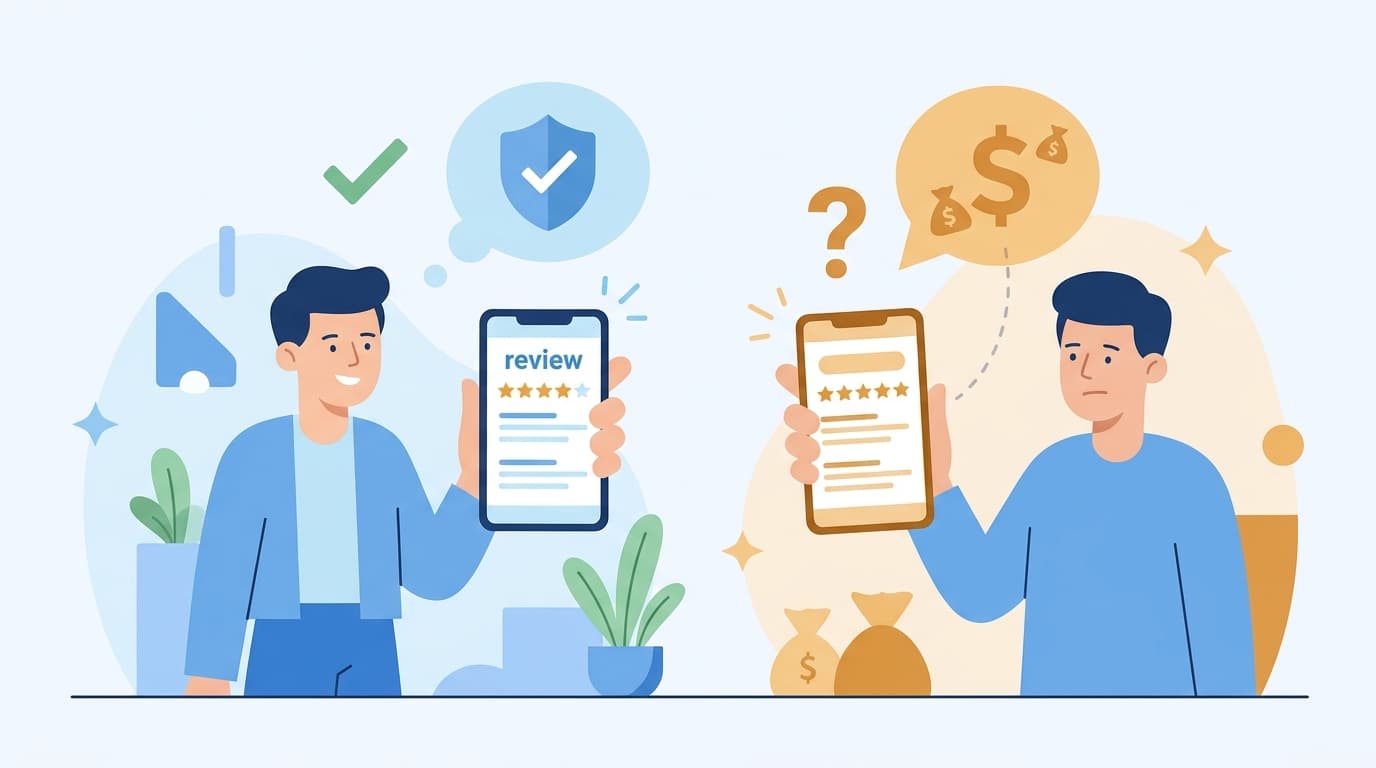
How to Tell a Genuine Review from a Paid One
You can usually tell a genuine review from a paid one by looking at three things: the reviewer's history, the specificity of the language, and the timing of when the review was posted. Genuine reviews read like a person describing their own experience with real details - a size that ran small, a delivery that took nine days, a support email that actually got answered. Paid or fake reviews tend to use generic praise, appear in sudden clusters, and come from accounts with little other activity. None of this requires special tools; it just means slowing down and reading like a skeptic for two minutes before you buy.
What does a genuine vs paid review actually look like?
A genuine review usually mentions something specific to the product or service that a copywriter wouldn't bother inventing - a minor flaw, a particular use case, or a comparison to something else the reviewer tried. Example: "The zipper on the left pocket sticks a bit, but it's held up fine after six months of daily commuting." That level of detail is hard to fake convincingly at scale.
A paid review tends to read like ad copy wearing a disguise. It praises the brand broadly ("amazing company, highly recommend!"), rarely mentions a downside, and often repeats phrases you'll find in the company's own marketing material or product description. If a five-star review sounds like it could have been written before the product even shipped, treat it as suspect.
How can I check if a reviewer's account is real?
Click on the reviewer's name or profile if the platform allows it (Amazon, Google Maps, and Trustpilot all do this). Look for:
- Review history: A real customer usually has reviews scattered across different, unrelated products or businesses over time. An account with 15 five-star reviews posted in the same week, all for unrelated small brands, is a strong sign of paid activity.
- Account age: On Google Maps, you can see how long a reviewer's profile has existed. Brand-new accounts with only one glowing review are common in review-buying schemes.
- Verified purchase tags: Amazon marks reviews as "Verified Purchase" when the reviewer actually bought the item through the platform at a price not heavily discounted. A review without this tag isn't automatically fake, but a pattern of unverified five-star reviews on a product is worth noticing.
Why do reviews suddenly appear in clusters?
A real product or service collects reviews gradually, as actual customers finish using it. A sudden spike - say, 40 five-star reviews posted within three days on a listing that previously had five - usually means someone ran a review campaign, whether through a paid review service, a discount-for-review deal, or an incentivized email blast. You can spot this on Amazon by sorting reviews by "Most Recent" and watching the dates; on Google Business Profiles, Google's own review graph (visible when you click into the reviews section) shows review volume over time and will show the spike clearly.
What language patterns show up in paid reviews?
Researchers and fraud investigators who study fake reviews point to a few recurring patterns, and you can check for these yourself:
- Overuse of the brand or product's full name within the review, which reads unnaturally ("I love my [Brand Name] Pro X2000!") - genuine reviewers rarely repeat the full product name.
- Excessive exclamation points and superlatives ("best purchase of my life!!") without any concrete detail backing it up.
- Reviews that read like a list of marketing bullet points rather than a personal account - mentioning "fast shipping, great quality, excellent customer service" without describing what actually happened.
- Near-identical phrasing across multiple reviews on the same listing. Copy a suspicious sentence and search for it in quotes on Google - if it appears word-for-word on other sites or other reviews, that's a strong red flag.
Do negative reviews get faked too?
Yes. Competitors sometimes pay for negative reviews to damage a rival business, and the same red flags apply in reverse: vague, dramatic complaints with no specifics ("worst company ever, total scam") posted by accounts with no other review history. A genuine negative review usually explains exactly what went wrong - a specific order number issue, a support response that took too long, a product that broke after a specific number of uses.
Are there tools that can help me check reviews?
Yes, a few free ones are worth knowing:
- Fakespot analyzes Amazon, Walmart, and other retail listings and grades the reliability of the reviews based on patterns in reviewer behavior and language.
- ReviewMeta does something similar for Amazon, flagging listings with unusual review timing or reviewer patterns.
- Google's own "About this result" and review summary tools on Business Profiles show review volume trends over time, which helps you spot artificial spikes without any third-party tool.
These tools aren't perfect and shouldn't be the only thing you rely on, but they're a fast second opinion when a product's reviews feel off.
What should I actually do before trusting a review?
Read the three-star and two-star reviews first, not just the five-star ones. Middling reviews are harder to fake convincingly because they require describing specific trade-offs rather than blanket praise or blanket complaints. Check a handful of reviewer profiles for history and account age. Sort by most recent and watch for unnatural clusters. And search for a distinctive sentence from a review in quotes to see if it's been copy-pasted elsewhere. None of these steps take more than a few minutes, and together they catch the overwhelming majority of paid or fake reviews before you ever hand over your payment details.
Frequently Asked Questions
What is the fastest way to spot a fake review without using any tools?
Read the review and ask whether it mentions a specific, mildly negative or neutral detail that a copywriter wouldn't bother inventing, like a sticking zipper or a nine-day delivery. If the review only offers broad praise with no downside and sounds like it could have been written before the product shipped, treat it as suspect. This takes about two minutes per listing and requires no special software.
Does the absence of a 'Verified Purchase' tag mean a review is fake?
No, a single unverified review isn't automatically fake since people can leave honest reviews without buying through the platform. However, a pattern where many or most of the five-star reviews on a product lack the Verified Purchase tag is worth noticing and treating as a warning sign. Amazon applies this tag specifically when the reviewer bought the item through the platform at a price that wasn't heavily discounted.
How many reviews posted at once should be considered a suspicious spike?
There's no fixed universal number, but the article gives an example of 40 five-star reviews appearing within three days on a listing that previously had only five - that kind of sudden jump is a clear red flag. The key signal is the contrast between a long period of slow, gradual review growth and a short burst of many similar reviews. You can check this pattern on Amazon by sorting reviews by 'Most Recent' or on Google Business Profiles using the review volume graph.
Can checking reviewer account age help identify paid reviews on Google Maps?
Yes, Google Maps lets you view how long a reviewer's profile has existed, and brand-new accounts that have posted only one glowing review are a common pattern in review-buying schemes. This is different from Amazon, where account history is harder to inspect directly, making the review history and verified purchase tag more useful signals instead. Combining account age with review history gives a fuller picture of whether an account looks like a real customer or a paid one.


