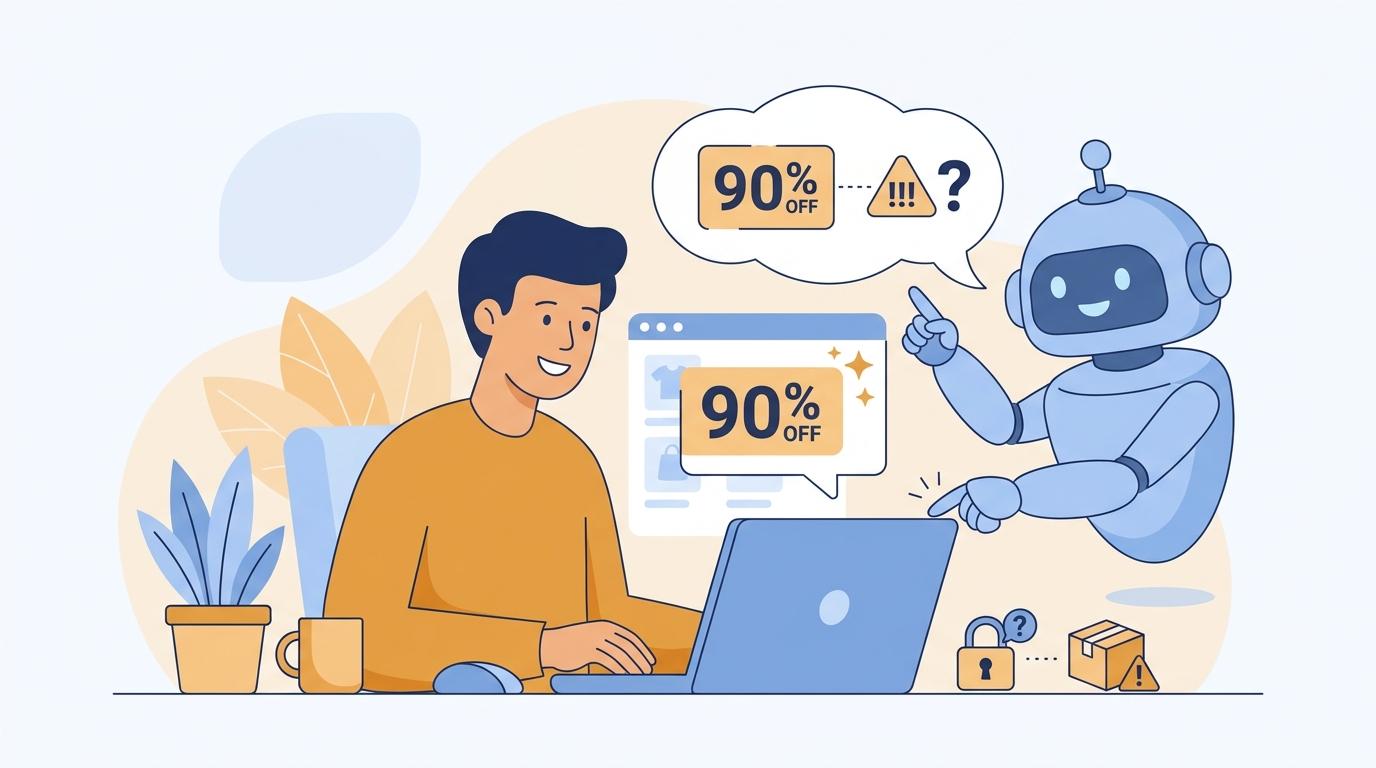
Why Too-Good-to-Be-True Discounts Are Often a Scam Warning Sign
An online store discount scam warning usually looks the same everywhere: a designer bag at 85% off, a $900 phone for $120, or "closing down sale, everything must go" on a site you've never heard of. If a discount is deep enough to seem absurd compared to the item's normal retail price, treat it as a warning sign first and a bargain second. Real retailers run sales, but they rarely sell below cost, because that's not a sale - it's a loss they have no reason to take.
This doesn't mean every discount is fake. Clearance stock, overstock liquidation, and end-of-season sales are real and can hit 50-70% off. The difference is context: who's selling it, why, and whether the rest of the site holds up to a closer look.
What counts as an online store discount scam warning sign?
A few patterns show up again and again in fake discount schemes:
- The discount percentage is identical across the entire store - every item, every category, marked down by the same 70-80%, regardless of brand or demand.
- A countdown timer resets - refresh the page and the "sale ends in 2 hours" clock starts over. That's a pressure tactic, not a real deadline.
- The crossed-out "original price" is inflated - a jacket listed as "was $400, now $89" when the same jacket sells for $95 everywhere else.
- Stock counters that never move - "Only 3 left!" stays at 3 left no matter how many times you reload or how many days pass.
- The brand name is slightly off - "Nikee," "Pandorra," or a logo that's almost right. This is common on sites impersonating known retailers.
How do I check if a discounted price is real?
Search the exact product name or model number on Google Shopping or a price-comparison tool and see what it sells for elsewhere. If three or four other retailers list it at $150 and this one site has it at $35, that gap is the tell. Legitimate liquidation and clearance pricing usually tracks within 40-60% of retail, not 90% off. Also check the product photos: right-click (or long-press on mobile) and run a reverse image search. Scam stores frequently lift photos directly from the real brand's site or from Amazon listings, and a reverse search will show you the original source.
What else should I check besides the price?
The discount is the hook, but the rest of the site usually confirms the problem:
- Domain age - look up the site on a WHOIS lookup tool (like who.is). A domain registered a few weeks or months ago, selling "luxury" goods at clearance prices, is a strong indicator of a short-lived scam storefront.
- Contact information - check for a working phone number, a real street address, and a return policy with actual terms. If the only contact method is a web form or a generic Gmail address, that's a gap most legitimate retailers don't have.
- Checkout and payment options - if the only payment method is a direct bank transfer, wire transfer, or cryptocurrency, and there's no credit card or PayPal option, walk away. Card payments give you a dispute process; bank transfers and crypto generally don't.
- Reviews outside the site itself - search the store name plus "review" or "scam" on Google, and check independent review platforms rather than only testimonials shown on the store's own homepage, which the store controls entirely.
- Spelling and site polish - broken English in product descriptions, inconsistent fonts, or a checkout page that looks different from the rest of the site can indicate a template thrown together quickly.
Why would a scam site bother with fake discounts at all?
Deep discounts solve the scammer's two biggest problems at once: getting your attention and getting you to decide fast, before you think to check anything. A steep percentage off makes a stranger's store feel like a limited opportunity instead of a risk. It also explains, in the shopper's mind, why an unfamiliar brand would be this cheap - "it's a sale" feels like a normal reason, so people stop asking harder questions. The goal isn't usually to send you a fake product (though some sites do that, shipping cheap counterfeits from overseas). Often the goal is simpler: take your card details and either charge you more than agreed, enroll you in a recurring subscription you didn't notice, or never ship anything at all.
What should I do if I already paid on a site like this?
Contact your card issuer or bank immediately and ask about a chargeback - most card networks allow disputes for goods that never arrive or were misrepresented, typically within 60-120 days of the transaction. Change your password if you reused one for that account anywhere else. If you used a debit card linked directly to your bank account, report it right away, since debit disputes often have tighter time limits than credit card disputes. Screenshot the product listing, the price, and the checkout page before the site potentially goes offline - this documentation matters if you need to file a dispute or report the site.
How can I shop sales safely without missing real deals?
Stick to retailers you can verify independently of their own claims. Before buying from an unfamiliar store, spend two or three minutes checking the domain age, searching the exact product price elsewhere, and reading reviews from a source the store doesn't control. A real discount will survive that scrutiny. A fake one usually falls apart the moment you look past the price tag.
Frequently Asked Questions
Is an 85% discount always a scam?
Not always, but it's a strong warning sign that deserves scrutiny. Legitimate clearance, overstock, and end-of-season sales can reach 50-70% off, but discounts beyond that, especially sitewide and on new or branded items, usually mean the seller is either lying about the original price or not planning to ship the item at all. The key is checking context: who's selling, why, and whether the rest of the site holds up.
Why do scam sites use countdown timers and low stock counters?
These are pressure tactics designed to make you buy before you have time to research the seller or compare prices elsewhere. A real deadline doesn't reset when you refresh the page, and a real stock count changes as items sell or time passes. If the timer resets or the "Only 3 left" counter never moves no matter how many days go by, it's a fake urgency trick rather than genuine inventory data.
What payment methods should make me suspicious of an online store?
If a site only accepts direct bank transfer, wire transfer, or cryptocurrency and offers no credit card or PayPal option, that's a major red flag. Card and PayPal payments give buyers a dispute or chargeback process if the item never arrives or is fake, while bank transfers and crypto payments are generally irreversible once sent. Legitimate retailers almost always offer at least one of these reversible payment options.
How can I tell if product photos on a discount site are stolen?
Right-click the image on desktop or long-press it on mobile and run a reverse image search through Google Images or a similar tool. Scam storefronts frequently copy photos directly from the real brand's official site or from existing Amazon listings instead of taking their own, and a reverse search will reveal the original source. If the same exact photos trace back to a different, unrelated seller, that's a clear sign the store isn't the actual brand or an authorized retailer.